Wanted to share our film on Assam for Al Jazeera International (AJ). It’s been a while but the topic errupted yesterday when I was narrating our filming experience to a journalist friend. The Indian Army & the Intelligence gave us a pretty hard time throughout our journey in Assam. Hmm. We finally managed to film it. Just us two ladies and of course our driver. Three person crew. Btw, The film had to go on one name and Hazel having more experience was selected but like I care. Assam’s situation has been shown for the first time in AJ. Jobs’ done!
I understand it’s a grim subject . Assam is much more stable today than it was 5 years ago but we city dewellers shouldnt forget that prople are still suffering. My heart goes out to the people in the remote corners of Assam who have faced the unrest till date. All said and done, if we don’t tell our own stories, WHO WILL???
(Part 1 of the film below)
(Part 2 of our film) -
There were a lot of conspiracy going on while we were filming this documentary in Assam. Why would AL Jazeera be suddenly interested in Assam? Laden’s “so called spy’s “ are here. It gave us a bit of a laugh and I was in the papers for all the wrong reasons until I directly went to the required personal and levelled things up. After that it was a smooth ride...well ,sort of!
But the truth is, It took me six months to convince Al Jazeera to bring Assam’s Unrest to the world audience. My last pitch that worked was: Our men, women and children are also dying. Both rebels as well as armed force families have been effected and suffered. Do you mean they are not worthy enough of your TV slot? There has been unrest there for more than 30 years and you only concentrate on the middle east and Afghanistan. Wake up and smell the coffee.
Part 2:
Showing posts with label asom. Show all posts
Showing posts with label asom. Show all posts
Sunday, 26 June 2011


Thursday, 3 December 2009
The past emerged suddenly
I landed at Indira Gandhi International Airport in the wee hours of the morning. Bahadur and Lucky Singh were waiting outside to drive us to the domestic airport where we shall take our connecting flight to Guwahati. I was glad to leave behind the cold London winter and was looking forward to a few weeks of being pampered by my family. Just as I parked myself at the executive lounge for a cat nap, the Television Breaking news broke my sleep let alone my jetlag - Arobindo Rajkhuwa (AR) arrested. It brought back memories of my documentary on Assam. Too many thoughts gushed through my mind....
India Trip 2005: There comes a time in your life where you finally want to walk the walk and talk the talk. This was such a trip. I just showcased my first short film and the success it had at Cannes International Film Festival, France; boosted my adrenalin to embark on my burning desire within- A documentary on the families of ULFA.
Now, I am far from being a journalist. The only experience I have, like many, is that I grew up in the dysfunctional state of Assam in the mid eighties. My questions were from my gut, from a housewife, from a daughter of the same soil. I wanted to capture the humane aspect of it from a common man/woman’s perspective. The only rule I had for myself -don’t have any judgements, don’t show any emotions. Let them talk- this story is about them- not YOU. You shall get your answers along the way. Have patience. Easier said than done! I wanted to react badly to most of their answers but somehow refrained myself from doing so.
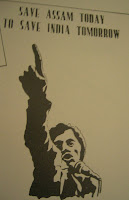
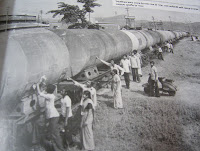
I had a sheltered childhood even though I was not remotely affected by the uprising. The only few memories I had was that when the lights went off while we were studying in the evenings, the black outs happened and in that silence one could hear gunshots in the nearby hills.... A man in the middle of the road in broad daylight, not far from my house had cut his chest and wrote from his blood- We Will Give Blood But Not Oil. (Tez Dim, Tel Nideu).. as if a warning to the Indian Government to stop exploiting Assam of its richness and to give back more. The road procession to Oil India campus during the Assam Agitation.. The endless trail of people walked passed our front door. I remember my parents getting buckets of water for the thirsty protesters. Today Assam has been liberally ploughed back with ample of money from the Central Government. The Assam Agitation followed by the new robin hoods that emerged and drifted away from the non violet agitators formed an armed group i.e. ULFA which had mass support and later the same ‘janta’ disowned them. What went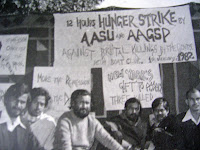
 wrong? What provoked or what motivated them to take up arms in the first place? What did they do to lose the trust from society later?
Friday December 23rd : Armed with just my driver in my dad’s old ambassador car, along with a trusted friend who could handle my camera, I was on my way to Upper Assam; to capture on film and to quench my thirst on a story what started as an uprising in the history of Assam: the formation of the most wanted separatist group in India- United Liberation Front of Assam (ULFA).
My documentary revolves around the families of the banned outfit. For me, they are the real heroes, who despite all the harassment & humiliation, continues to survive and live within the society. The courage and endeavour they must have been through- their only fault being that they belonged to families of the banned outfit. Being under scrutiny 24/7, their phone calls tapped, insulted at their own premises, getting threatening calls, mental harassments and sometimes even physical torture for something they have not done makes me wonder how they cope with it all and still continues to smile and live a normal life. I love my privacy and thinking of it makes me cringe.
My first destination was Arobindo Rajkhuwa’s place in Lakuwa, a remote corner in Assam’s Sibsagar district. One evening I contacted Rajkhuwa’s brother Ajoy in a very seedy hotel in Poltonbazar, Guwahati. I was apprehensive but he turned out to be a middle aged, decent and humble man. After a little chat with me, he invited me to his place the following week and that is where I was heading. I was lost in Sibsagar. My flashy cell phone lost its network too and I stopped to make a phone call only to find out that it was a police reserve. There I was in the beginning of my journey- lost network, no proper destination address and not a single known face around me. As we drove down the dark narrow bumpy road with little electricity, it made me wonder how a boy from this remote area had a vision for his land. It’s usually the have-nots that have it in them and AR was a true example.
I wanted to reach before dusk but failed to do so. The Rajkhuwa household had prepared a feast but my sole intention was to have a word with Aaita, Rajhkuwa’s ailing mother. I wanted to have a quiet moment with her but that was impossible as the entire dynasty gathered to be introduced and I was being my decent self exchanging pleasantries. By the time I got Aaita all for myself, my camera light was not working and I had to film in whatever light that was available there.
Aaita was a frail yet emotionally strong lady. She could barely see and felt my hands most of the time. She hoped that I would bring back her son which I rectified. I was there to talk to her about my documentary. Regardless, we talked. Her emotions were just unfolding and all I did was held her hand. She is in her nineties yet her strength made me feel weak. The more we talked; anger filled my mind for her son and a question inside- How could she still long for him after all the unpleasantness she endured from the army and society. He misled her from the very beginning. One morning as she was weaving in her front veranda, he clicked one last snap of his mother saying that he was off to the Namghar (shrine) for a few weeks. Months later she found out that he had joined the outfit.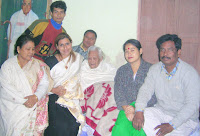
Aaita has lived many lives in one lifetime. She had the pride of being a freedom fighter’s wife. Years later, she was the Indian army’s target for being AR’s mother. If that was not enough she lost her first son to the secret killings that took place in the state. I have become almost blind crying all the time she said but I still hope to see xorupai (my youngest) one day. My last question to her: what will you say to him if you see him today? Without batting an eyelid she said- Ghoroloi gusi ah. Kheti kori kha- (Come home. Lead a simple farmer’s life here). I got very little sleep that night. Her words and her face were on my mind and added anger filled my mind for her son. My journey continued but her face stayed on my mind forever.
Back home in London I sat down to write to Arobindo Rajkhuwa- about my interaction with his mother and an email accusing him of what he had done to his mother and how could he hurt her deliberately. It was an email where I bombarded him with allegations and verbal brutality as I was certain, it would be a one way street. To my surprise an email arrived from the chairman himself, nothing aggressive compared to mine. Just saying -thank you for seeing my mother and for the photos. I miss her and have seen her after a very very long time. The last few last words saying - my motherland is greater than my mother.
Now this very man has been handed over by the Bangladesh government to the Indian intelligence. This all happened while he was just about to execute his exit from Bangladesh with his family and take a new secured shelter elsewhere. All we know is that no one has seen him since he joined the group. As I write this in Guwahati, he is just a few yards away from my home in Kahilipara where he is in safe housing. The media will flash his face over and over again from now onwards as the founder member and chairman of ULFA in custody. The Government might think that they just won a jackpot and that the key to their problem is under manacles.
The peace talks might be renewed but that to me is like boys with toys in a school playground- I shall bat, you ball and vice versa. You give me my boys back, we regroup, get stronger or is it just another senior level strategy that I have lost fate in?
These to me are very cosmetic. This will not get back our sheltered childhood, nor will it bring solace to the mothers who lost their loved ones in the decades of tragedy. Not even to the lady I met in Nowgaon during my filming, she had two sons- one joined ULFA, the other joined the police force- sadly both died- who is actually benefiting from this? Definitely not the people of Assam who are the real sufferers. Has anyone bothered to even ask their opinion?
Unless the government takes sovereignty in the agenda, no talks will happen with ULFA says their Commander in Chief Poresh Barua. Sovereignty is not in the constitution of the Indian Government. Now, the Indian constitution is a wonderful document and it can be amended as it has had 94 amendments in less than 60 years of its enactments. So what’s the harm in putting the word Sovereignty in the agenda? Amendments do not grant sovereignty, it will just open a dialogue and perhaps save millions of innocent lives and destructions in the coming years. What’s more important for the government? I feel everything in this world can be solved if people talk. The Government can decide if they want to amend the constitution again. Big Deal!
However, if we can address as to why it all started and if we can amicably solve that, I think we are laughing!
Bublee
India Trip 2005: There comes a time in your life where you finally want to walk the walk and talk the talk. This was such a trip. I just showcased my first short film and the success it had at Cannes International Film Festival, France; boosted my adrenalin to embark on my burning desire within- A documentary on the families of ULFA.
Now, I am far from being a journalist. The only experience I have, like many, is that I grew up in the dysfunctional state of Assam in the mid eighties. My questions were from my gut, from a housewife, from a daughter of the same soil. I wanted to capture the humane aspect of it from a common man/woman’s perspective. The only rule I had for myself -don’t have any judgements, don’t show any emotions. Let them talk- this story is about them- not YOU. You shall get your answers along the way. Have patience. Easier said than done! I wanted to react badly to most of their answers but somehow refrained myself from doing so.

I had a sheltered childhood even though I was not remotely affected by the uprising. The only few memories I had was that when the lights went off while we were studying in the evenings, the black outs happened and in that silence one could hear gunshots in the nearby hills.... A man in the middle of the road in broad daylight, not far from my house had cut his chest and wrote from his blood- We Will Give Blood But Not Oil. (Tez Dim, Tel Nideu).. as if a warning to the Indian Government to stop exploiting Assam of its richness and to give back more. The road procession to Oil India campus during the Assam Agitation.. The endless trail of people walked passed our front door. I remember my parents getting buckets of water for the thirsty protesters. Today Assam has been liberally ploughed back with ample of money from the Central Government. The Assam Agitation followed by the new robin hoods that emerged and drifted away from the non violet agitators formed an armed group i.e. ULFA which had mass support and later the same ‘janta’ disowned them. What went

 wrong? What provoked or what motivated them to take up arms in the first place? What did they do to lose the trust from society later?
Friday December 23rd : Armed with just my driver in my dad’s old ambassador car, along with a trusted friend who could handle my camera, I was on my way to Upper Assam; to capture on film and to quench my thirst on a story what started as an uprising in the history of Assam: the formation of the most wanted separatist group in India- United Liberation Front of Assam (ULFA).
My documentary revolves around the families of the banned outfit. For me, they are the real heroes, who despite all the harassment & humiliation, continues to survive and live within the society. The courage and endeavour they must have been through- their only fault being that they belonged to families of the banned outfit. Being under scrutiny 24/7, their phone calls tapped, insulted at their own premises, getting threatening calls, mental harassments and sometimes even physical torture for something they have not done makes me wonder how they cope with it all and still continues to smile and live a normal life. I love my privacy and thinking of it makes me cringe.
My first destination was Arobindo Rajkhuwa’s place in Lakuwa, a remote corner in Assam’s Sibsagar district. One evening I contacted Rajkhuwa’s brother Ajoy in a very seedy hotel in Poltonbazar, Guwahati. I was apprehensive but he turned out to be a middle aged, decent and humble man. After a little chat with me, he invited me to his place the following week and that is where I was heading. I was lost in Sibsagar. My flashy cell phone lost its network too and I stopped to make a phone call only to find out that it was a police reserve. There I was in the beginning of my journey- lost network, no proper destination address and not a single known face around me. As we drove down the dark narrow bumpy road with little electricity, it made me wonder how a boy from this remote area had a vision for his land. It’s usually the have-nots that have it in them and AR was a true example.
I wanted to reach before dusk but failed to do so. The Rajkhuwa household had prepared a feast but my sole intention was to have a word with Aaita, Rajhkuwa’s ailing mother. I wanted to have a quiet moment with her but that was impossible as the entire dynasty gathered to be introduced and I was being my decent self exchanging pleasantries. By the time I got Aaita all for myself, my camera light was not working and I had to film in whatever light that was available there.
Aaita was a frail yet emotionally strong lady. She could barely see and felt my hands most of the time. She hoped that I would bring back her son which I rectified.
 I was there to talk to her about my documentary. Regardless, we talked. Her emotions were just unfolding and all I did was held her hand. She is in her nineties yet her strength made me feel weak. The more we talked; anger filled my mind for her son and a question inside- How could she still long for him after all the unpleasantness she endured from the army and society. He misled her from the very beginning. One morning as she was weaving in her front veranda, he clicked one last snap of his mother saying that he was off to the Namghar (shrine) for a few weeks. Months later she found out that he had joined the outfit.
Aaita has lived many lives in one lifetime. She had the pride of being a freedom fighter’s wife. Years later, she was the Indian army’s target for being AR’s mother. If that was not enough she lost her first son to the secret killings that took place in the state. I have become almost blind crying all the time she said but I still hope to see xorupai (my youngest) one day. My last question to her: what will you say to him if you see him today? Without batting an eyelid she said- Ghoroloi gusi ah. Kheti kori kha- (Come home. Lead a simple farmer’s life here). I got very little sleep that night. Her words and her face were on my mind and added anger filled my mind for her son. My journey continued but her face stayed on my mind forever.
Back home in London I sat down to write to Arobindo Rajkhuwa- about my interaction with his mother and an email accusing him of what he had done to his mother and how could he hurt her deliberately. It was an email where I bombarded him with allegations and verbal brutality as I was certain, it would be a one way street. To my surprise an email arrived from the chairman himself, nothing aggressive compared to mine. Just saying -thank you for seeing my mother and for the photos. I miss her and have seen her after a very very long time. The last few last words saying - my motherland is greater than my mother.
Now this very man has been handed over by the Bangladesh government to the Indian intelligence. This all happened while he was just about to execute his exit from Bangladesh with his family and take a new secured shelter elsewhere. All we know is that no one has seen him since he joined the group. As I write this in Guwahati, he is just a few yards away from my home in Kahilipara where he is in safe housing. The media will flash his face over and over again from now onwards as the founder member and chairman of ULFA in custody. The Government might think that they just won a jackpot and that the key to their problem is under manacles.
The peace talks might be renewed but that to me is like boys with toys in a school playground- I shall bat, you ball and vice versa. You give me my boys back, we regroup, get stronger or is it just another senior level strategy that I have lost fate in?
These to me are very cosmetic. This will not get back our sheltered childhood, nor will it bring solace to the mothers who lost their loved ones in the decades of tragedy. Not even to the lady I met in Nowgaon during my filming, she had two sons- one joined ULFA, the other joined the police force- sadly both died- who is actually benefiting from this? Definitely not the people of Assam who are the real sufferers. Has anyone bothered to even ask their opinion?
Unless the government takes sovereignty in the agenda, no talks will happen with ULFA says their Commander in Chief Poresh Barua. Sovereignty is not in the constitution of the Indian Government. Now, the Indian constitution is a wonderful document and it can be amended as it has had 94 amendments in less than 60 years of its enactments. So what’s the harm in putting the word Sovereignty in the agenda? Amendments do not grant sovereignty, it will just open a dialogue and perhaps save millions of innocent lives and destructions in the coming years. What’s more important for the government? I feel everything in this world can be solved if people talk. The Government can decide if they want to amend the constitution again. Big Deal!
However, if we can address as to why it all started and if we can amicably solve that, I think we are laughing!
Bublee
Friday, 1 February 2008
Monday, 16 July 2007
Attempting my first Assamese Sonnet !
The sun is about to set, the water in the pond had a glittering golden shine to it. In our film language we call this the magic hour. Most stunning photography is done during this time of the day. It was a long awaited trip to the tea gardens. I badly needed some time to switch off from my schedule. Minku and Tuki are close friends and we had the privilege to meet them in Muktabari Tea Estate.
As my other half caught up with his friend sharing an old monk, I drifted away to the backyard. Surrounded by fresh garden leaves stood an Assam-Type house with a pond flowing nearby. White ducks swayed in it. It looked even brighter under the shadows of the sun that will soon disappear. The stillness in the air except an odd bird chirp made the moment last in my mind. As I heard echoes of laughter coming from the front garden, I parked myself at the edge of the pond.
A sudden urge prevailed in me to write something… something completely foreign. I wanted to express in a language I never dared to write before although I proudly call it my mother tongue.
Shame on me! I was writing my first Assamese Sonnet in English. I decided to dedicate it to the pond (read river) and Minku’s beautiful backyard
Misiki ke hahi mari
Nemata kaile baru tumi
Ojaan ojaan lage jodiu
Lage kionu, ojibonor aamar aai enazoree
Junak raati, xitol botahor majere
Kee nu koi gola tumi?
Bujibo khujileu janu, paam ne buji tumar monor kotha khini khuli ?
As my other half caught up with his friend sharing an old monk, I drifted away to the backyard. Surrounded by fresh garden leaves stood an Assam-Type house with a pond flowing nearby. White ducks swayed in it. It looked even brighter under the shadows of the sun that will soon disappear. The stillness in the air except an odd bird chirp made the moment last in my mind. As I heard echoes of laughter coming from the front garden, I parked myself at the edge of the pond.
A sudden urge prevailed in me to write something… something completely foreign. I wanted to express in a language I never dared to write before although I proudly call it my mother tongue.
Shame on me! I was writing my first Assamese Sonnet in English. I decided to dedicate it to the pond (read river) and Minku’s beautiful backyard
Misiki ke hahi mari
Nemata kaile baru tumi
Ojaan ojaan lage jodiu
Lage kionu, ojibonor aamar aai enazoree
Junak raati, xitol botahor majere
Kee nu koi gola tumi?
Bujibo khujileu janu, paam ne buji tumar monor kotha khini khuli ?
Sunday, 4 March 2007
An elephantine orphanage in Asom

We've all heard of orphanages for children, but one for elephants is rather hard to believe.
The Wildlife Trust of India (WTI) has set up a first-of-its-kind orphanage centre for elephants inside the Manas National Park in Asom.
The Assam Elephant Orphanage Centre, which is to be inaugurated on Saturday, was established in wake of the increasing number of animals, particularly elephants, becoming orphan in the state.
The Deputy Chief of Bodoland Teritorial Council (BTC) Kampa Borgoyary will introduce three elephant calves in the orphanage on its inauguration. Three others would be introduced later under the supervision of WTI.
The International Fund of Animal Welfare (IFAW) would also extend support to the project and also to other cases of wildlife destitutes.
Elephants Released Into Wild for First Time in India

(Assam, India – 26 February 2007)
IFAW (International Fund for Animal Welfare) and its partner, WTI (Wildlife Trust of India) today announced that six elephant calves have been successfully released to the wild in Manas National Park.
The elephants—which were hand-raised at the Centre for Wildlife Rehabilitation and Conservation (CWRC)—were transported 450 kilometers from India’s Kaziranga National Park to Manas National Park.
Background of the elephants
* On August 28, 2002 CWRC staff rescued a two-week-old elephant calf (male) from a trench on the Numaligarh tea estate. The orphaned calf was brought to CWRC for care. The elephant is now five years old.
* The second elephant calf (male) was one-year-old when it was rescued from flood waters in Digboi by the forest department and brought to the centre on December 8, 2002. The elephant is now six years old and the oldest of the calves.
* The third elephant calf (male) was rescued by CWRC staff from Koliabor near the town of Tezpur on October 3, 2003. It had been stranded and orphaned. The elephant is now three-and-a-half-years old.
* The fourth elephant calf (female) was rescued from the Rupajuli tea estate in Tezpur by estate workers on September 23, 2004. The two-month-old animal had been injured after it fell in a trench and was displaced from its herd. The animal was handed over to CWRC for care. The elephant is now two-and-a-half-years old.
* The fifth elephant calf (female) was rescued from the Barsapori tea estate by estate workers on October 14, 2004. The two-month old calf was displaced from its herd and was handed over to CWRC for care. The elephant is now two-and-a-half-years old.
* The sixth elephant calf (male) was about one-year-old when it was rescued from the Numaligarh tea estate on October 19, 2004 and brought to the centre for care. The elephant is now three-and-a-half-years old.
In Manas the elephants will be reintegrated into a wild herd once they are familiarized with the area. It is the first time elephants have been rehabilitated and released to the wild in India. Sri Lanka and Kenya are the only other countries to have successfully released hand-raised elephants into the wild.
“The elephants will be allowed to move freely in the jungle during the daytime under the supervision of a keeper,” said Dr. N. V. K. Ashraf, Director Wild Rescue of WTI. “At night, for their security, they will be sheltered in a stockade built in an area of about one hectare [about 10000 sq. meters].”
The elephants were transported to an area of Manas called Doimari, an ideal elephant habitat located far from the nearest human habitation. It is the biggest continuous forest habitat (unfragmented habitat) in India’s north-east region and extends from the Indian state of Assam up to the country of Bhutan.
“All six elephants are being radio-collared for post-release monitoring. If there is a problem we can find and rescue them,” said Dr. Bhaskar Choudhry, wildlife veterinarian of WTI.
The six elephants, which range between two-and-a-half and six-years-old, were hand-raised at the rehabilitation center (CWRC) in Kaziranga. The young calves were rescued from different parts of Assam and have been at the centre from one-to-five years. CWRC is India’s first multi-species rehabilitation facility and was set-up in partnership between WTI, IFAW, and the Assam Forest Department.
M. C. Malakar, Chief Wildlife Warden, Assam and D. M. Singh, Kaziranga Park Director were present at the elephants send-off from the centre in Kaziranga. Kampa Borgoyari, Deputy Chief of the Bodo Territorial Council (BTC) received the elephants in Manas.
A six-member veterinary team comprising doctors from the College of Veterinary Science, Guwahati, Dr. Bijoy Dutta and Dr. Bhupen Sarma, Dr. Bhaskar Choudhry, Dr. Anjan Talukdar, and Dr. Ashraf of WTI, and Dr. Raj Jyoti Deka (as independent consultant) accompanied the elephants on their journey from Kaziranga to Manas.
A. J. Cady, Director Animals in Crisis and Distress, IFAW, and Vivek Menon, Executive Director, WTI also joined the elephants. Mr. Cady symbolically released the elephants in Manas, signifying arrival to their new home. The exercise is part of the elephant rehabilitation programme initiated by WTI and IFAW with support from the Assam Forest Department.
For media-related inquiries, contact:
Chris Cutter (IFAW, US)
Tel: +1 (508) 737-4623
Email: ccutter@ifaw.org
Mandeepa Ahluwalia (WTI)
Tel: +91 981 168 8851
Email: mandeepa@wti.org.in
Thursday, 22 February 2007
The National Games in Asom

It’s been a few years since we heard that the National Games would take place in Guwahati and along with it, came the speculations- can Chief Minister Tarun Gogoi and him team make it happen? Is it possible to even consider that such an event is feasible in a dysfunctional state like Asom? Of course Manipur had done it earlier and they probably have the highest rebel groups in North-East hence, equally if not more dysfunctional than us. I have to be honest here. The games being postponed several times, personally I gave up hope, went ahead and booked my filming schedule months in advance which I couldn’t change. My loss, as my shoot collided with the games.
All went well. The National Games indeed take place, ULFA kept their promise and the state did a fantastic job of hosting it. I badly wanted to be there cheering for our team. I have done that many a times as a child when Deuta was intensely involved with the Bordoloi Trophy. Cinema and Sports have been around in our house as far as I can remember. We had players living with us as family members and the endless parties Maa hosted before our table tennis team left for the Nationals. I guess it also reminded me of my Badminton days. The unity, the power and of course the pride I had (by the way still do), when I represented the state once in Mini Nationals. Today, I think I will lose a game to an amateur but then, that’s another story.
I could empathise with the participants, their joy of not just representing the state but also being the host team and if that is not enough, appearing in the top three rankings, not to mention the pressure to win in “home grounds”. This confirms that regardless of us being stamped as a race of “lahe lahe” Asom won gold in speed races like swimming and cycling apart from the other sports. Despite carrying on army operations in some corner of the state, we are still capable of putting up international standard opening and closing ceremonies.
Watching glimpse of the opening ceremony in the telly, I literally had tears in my eyes and a strange sensation ran through my body when Monalisa Barua Mehta (Mithoo ba, as she is know to the family) held the torch. Now, she is one contribution Deuta had made single-handedly to the state and to the country. Those few minutes felt as if I was living every moment through her. Just like a lucid dream going back to yesterdays, where every now and again, Deuta used to carry me with him to Kanaklata Stadium where I was fed strawberry milkshakes out of see-through plastic cans and got pampered like a living doll by his colleagues and players…the summer training camps, the boiled eggs and stale toasts for breakfast in that dilapidated canteen behind the then RG Barua Guest House, the half-fan saloon where most of us got the same crew cut (be it men or women) the national and international coaches for table tennis and above all, the bubbling charged up atmosphere to play and win for the state. Stories Deuta used to fill us about his collaborations with his friend and mentor R G Barua, his experience in Seoul and Los Angels Olympics where Maa also accompanied him and she literally had to open the twist of her saador to show some inquisitive crowd as to how it is worn, the souvenirs that still stand in our living room as memories of those bygone years. Last week, I silently observed Deuta open his wardrobe and brush his old blazer that said Phani Sharma- Vice President (Indian Olympic Association). Being an excellent table tennis player during his youth (his peers still talk about his forehand) I can only wonder the emotions he must have been through during the past two weeks. Strangely, he never pushed us to play any game but gave us the atmosphere and perhaps he takes solace in the fact that all his four children represented the state in different games.
Anyway, coming back to my filming, my last interview was with the Chief Minister and being given passes to watch the closing ceremony by the man himself I thought it might be a good idea to let my hair down after the roller coaster exciting filming experience we had. Sitting among the 30,000 odd spectators and watching a colourful presentation I could feel the buzz around me. I am sure some of them might have been victims of terror or at least have been effected by it to a certain extend at some point of time but it felt like they were impatiently waiting for a new renaissance to flush away their pain which they found in the games.
Undoubtedly, Tarun Uncle deserves all the pat on his back for providing the platform to the state but we must take a moment out to thank and appreciate the hard work put in by the people who implemented it and turned it into a success.
My sincere thanks and appreciation to the labours, contractors, builders of the brand new stadiums, to the Assam Police, Guwahati City Police- constables to IGP Mallik who himself had been a victim of terror years ago) , all IPS officers, Security Forces, Players and their parents/family for their sacrifices and dedication, Nagaland for their first participation, Organisers, Coaches, Cooks, Cleaners, School Children and Celebrities for their splendid performances, Media, Commissioner Sports and National Games (IAS Officers) Director of Sports Dhruba Hazarika, Naba Kumar Das (IAS), ACC, Pradyut Bordoloi, Hemanta Biswa Sarma and their colleagues who came together to made it happen. I sincerely apologise if I have left out anyone which I sure must have. Nevertheless, your input is valued and admirable. Last but not the least I request the players of our state to continue marvelling in their respective sports in the coming years and take advantage of the wonderful facilities they have now, which we never had years ago.
This certainly proves that if we, the people of Asom want to achieve success, we can, provided we put our mind, heart and hands together unanimously. Like many reading this piece, it too makes me proud to be part of the same soil.
Sunday, 4 February 2007
Guwahati, February 3rd 2007

It rained at dusk today. The first shower we had this year. I had almost forgotten the smell of the red wet earth that I used to love as a child. I looked out of my window. The increasing sound of the drops that hit the tin rooftop next door drove me to our portico. It felt strange to re-live the moment under the silvery red sky. Birds flew away in flocks…they seemed to be in a hurry. The lightening on those far fetched hills caught my attention. Tall bamboo trees by our driveway danced to the tunes of the wind and that wet stray dog across the street?
Under the wooden shed of a small shop stood a half drenched man holding a live chicken by its legs and he stood still the whole time, as if, cursing the rain for the delay it had caused him. The chicken on the other hand looked rather confused, fluttering her wings every now and then. Cars and busses were slowing down and it was time to switch their headlights on. The rickshaw pullers with their water drenched eyes paddled harder just so to keep their momentum against the rain. A couple briskly walked pass, their handkerchiefs wrapped around their head acting as make-shift umbrellas. Distant hustling passer-bys voices echoed with the sound of the drops. My mother’s full bloomed Dahlias quenched their thirst and like my mood, loved every bit of it.
As the wind gush the curtains away, I got a glimpse of my niece in the next room, oblivion to the rain, training her sa-re-ga-ma with her brand new harmonium. For me it added music to the ambiance. The girl on the other side of the fence rushed to her backyard and haphazardly collected the clothes from the washing line, the lonely swing; water patiently dripping from the rain that has now stopped. It seemed to have washed away the dust it had collected over the winter. My heart wanted to feel, touch and dance with the rain but my whole new British attitude stopped me and sensibly reminded me of my impending commitments and that I couldn’t afford to sport a cold. Now with a slight chill in the air, I need to wrap myself up, pick that brewing cup of tea and get on with my mundane life.
Friday, 5 January 2007
Bidexot Apun Manuh (close ones abroad)
Bidexot Apun Manuh (BAM) is a popular Assamese television show that follows the lives of Assamese living abroad. Presented in a travelogue style, it interviews the Non Resident Assamese (NRA)'s in informal surroundings. Telecast over Guwahati Doordarshan Kendra(DDK) since 2001, the second series of BAM (Dwitiya) is currently telecast on DDK every Sunday at 7.30 pm (IST).
The show hosted and directed by Bobbeeta Sharma (first Miss North-East) has completed more than 150 episodes covering countries like USA, UK, Canada, Australia, Dubai, New Zealand, Singapore, Thailand, Austria, Switzerland, Germany, France, Netherlands and Norway so far.
Script:Jimoni Choudhury
Music: Manas Hazarika
Editor:Pranjal Phukan
Camera: Chinmoy Sharma, Sharad Verma, and Ravindra Badgaiyan
Producers: Chinmoy Sharma & Bobbeeta Sharma
Production House:Guwahati based "Sangita Advertising".
Watch the title song of (BAM) sung by Saju... a hit song among people of Assam.
The show hosted and directed by Bobbeeta Sharma (first Miss North-East) has completed more than 150 episodes covering countries like USA, UK, Canada, Australia, Dubai, New Zealand, Singapore, Thailand, Austria, Switzerland, Germany, France, Netherlands and Norway so far.
Script:Jimoni Choudhury
Music: Manas Hazarika
Editor:Pranjal Phukan
Camera: Chinmoy Sharma, Sharad Verma, and Ravindra Badgaiyan
Producers: Chinmoy Sharma & Bobbeeta Sharma
Production House:Guwahati based "Sangita Advertising".
Watch the title song of (BAM) sung by Saju... a hit song among people of Assam.
Friday, 27 January 2006
Making of "The Passage"
Assam Tribune May 2005
Only two Indian women filmmakers screened their films in Cannes this year. Vinta Nanda’s White Noise & Sanchayita Sharma with her film called The Passage (see more about the film in http://www.enazoree.com
Born and bought up in Guwahati, capital of Assam, Sanchayita now lives and works in London. She says about her film: “It is not a formula Bollywood film and I don’t have a track record in filmmaking. So I was not surprised when there weren’t many takers to fund it. But I believed in the story hence I saved for two years and when I fell short of money I literally made the rest of the film out of my credit card. But I wouldn’t like to advice anyone to do that though. Of course, the value of the British pound helped me as it was filmed in India.”
Before moving to London, Sanchayita had a successful television career in India as a Bollywood request show host, interviewing celebrities. The show "Your Request" was on air for a decade and was the first to hit the record of 100 episodes in Doordarshan North East. She also ventured into the theatre world and had remarkable reviews about her acting skills in plays like Romeo and Juliet (1998); Street Car named Desire (1999) and participated in the Nandikar International Theatre Festival (1998) with Seagull Group, a well known theatre company from Assam.
Excerpts from an earlier interview :
You come from a family that is connected with cinema? What was it like to grow up in that environment?
I was six when I discovered that people paid to watch movies. Since my father owned cinema halls, watching films was not just a regular event but film business was dinner table conversation too. Sholay was the first film I remember that hit my emotional cord. Maybe because the terror was psychological or perhaps I thought Sanjeev Kumar was my father’s look-alike, hence the pain every time I watched it. For me, Gabbar was the epitome of my filmy villain and the “distributor” word I often heard at home were my real live Gabbars.
North East of India has seen you in front of the camera for a while now. What inspired you to direct a film?
Yes, apart from my TV show which I had fun doing, school and college days brought me closer to a lot of theatre as an actor but I was looking for something more. The business part of filmmaking was more appealing to me rather than directing. To be honest, I never had the nerve to direct until quiet late in life when I saw Satyajit Ray’s Apu Trilogy. It was Ray’s and Kristov Kieslowski’s treatments that made me look at films from a different angle. It somehow gave me the confidence to direct one.
What was the experience like since this was your first film?
Chaotic! Huge learning experience. It needed a lot of planning, organising and researching. Coordinating things from London prior to production did help to an extent. But before I landed in Guwahati, all I had was my script, that too in English. I had to find someone to translate it to Assamese, choose my cast, film and edit it….all in three weeks of Christmas holidays.. I remember working for more than forty eight hours at a stretch. Finally, I was back to London with my final print.
How did you choose your crew being so far away?
My editor, Manas Adhikari was my contact in Guwahati. I’ve known him since my television days. We worked on the budget over email and phone. He understood my vision, so things were easier. Once I landed in Guwahati, he lined up people and we had a crew ready in no time. I was blessed that Suman Dowerah was my cameraman. We worked earlier during my “Your Request” days and he as a busy diary. It was good to work with him , this time behind the camera. He gave personal interest to my film, which was handy.
And the location?
When I was storyboarding my script, I drew the hut and a train line running behind it. Some of the dialogues and one particular shot demanded the train nearby. We went location hunting for two days but couldn’t find any. There were logistical issues. We couldn’t afford overnight stays so it had to be in and around town. Once, I visited our family farmhouse and yes, there was a train line passing by but there wasn’t any hut. So we built one. It was still cheaper than moving everyone to another location. Luckily, Dad was filling up the land due to the floods last year so I got help from the existing builders. In fact they were all in the film as part of the crowd and actors in the village play scene too. I visited a roadside hut, clicked exterior and interior pictures and gave it to my art director to replicate it. Perfect!
What about the cast?
Ah! that was the tricky part. I had Binoy Deka (who played the rebel) in my mind while writing the script. He is a friend from my theatre days and I knew he was apt for the role. Apart from that, I was clueless. I spoke to a few people from London but that didn’t work hence I physically met them once I was in Guwahati and started from there.
You had non actors in the film. How was it to work with them?
Yes, Two of them. Hari Dutta Das (Atoi) and driver Jagadish. But they were playing themselves. Hari Dutta Das was my aunt’s priest at her local Naamghar ( a holy shrine). We did some rehearsals with him but he was easy going. In fact his last scene was fantastic. His eyes said a lot, the lighting , background sound, even the creases of his Eri Sador (shawl) was perfect. We did this towards the end of the day when he was a little tired so that I could get that look. I simply asked him to follow my extempore words of sympathy but requested him to use just his eyes and face emotions as he would do in real life. We had it all in one take. Perfect! He turned out to be a serious actor. After we wrapped up filming he confessed that he was now more interested in acting than his day job. He is looking forward to his next shoot!
My original script had an old driver but during my pre-production days I was driven around town by Jagadish. During my interaction with him, I found out that he had a story to tell. There were several reasons for casting him. He could play himself and could be a “subtle”hint of a probable groom for Pokhili and the most important factor was that he served the rebels but came back home due to the love for his family unlike Bapukan, my catalyst, who was on the other side of the spectrum. I just framed the relevant questions and spoke to him. He answered me just like he did during my pre shoot days.
Apart from the non actors, I have to mention Dabuda (Prof. Tripathi, who lead me to the wonderful Nikumoni Ba who so seamlessly flowed into her character. Also a special mention should go to Linu Aunty (Aatoi’s wife). She was my mother’s find and I thank my lucky stars that she took up this role. During my initial meeting with her, I had my doubts but reluctantly went ahead after some confirmation from my mum. Linu Aunty is a sophisticated lady and she would be playing something entirely opposite to what she is in real life. She really surprised me with her dedication and hard work. Just before the shoot I see her soaking a brand new mekhela sador in used black tea to get the faded look. She was the voice of my film and she did a fantastic job with it. Can’t complain!
You were very particular about the music in the film. Is that correct?
It is a film based on rural Assam. Guitar and keyboards simply won’t fit in. I wanted authentic Assamese music. My crew recommended Tarali Sarma, a well known singer in Assam. Apparently Tarali and I went to school together. It was great working with an old mate. I love Goalporia lokogeet. There seems to be pathos in this music which blended well with my film. Tarali gave me a combination of Kamrupia and Goalporia which was impressive. Even the first chase scene was done on doba and dhol.
Which was the best shot in the film according to you?
I think you should ask my viewers. Well, the ending shot of Atoi was moving. But I was personally pleased with the last shot, the reason why I called it “The Passage”. It was exactly how I visualised it to be. The car moves through a hump before entering the tunnel and disappears into the endless tunnel signifying that they had left the darkness behind and going into a brighter world which was seen at the far end, a kind of situation Assam is at the moment. We hope to see the bright side of the tunnel someday soon. For me, it said a lot about the film. Short films are suppose to leave the viewers with a question which I think the shot did but then again this is just my opinion. Some viewers will like it, some might not but that is filmmaking for you. You cannot make a film for everybody.
Anything interesting that happened during the shoot?
We had a great team, so filming was fun. During breaks, Atoi entertained us with his mythological tales and his new outlook as an actor and the film world. I particularly remember one incident. The night we were to shoot the jungle chase scene, the huge HMI lights were ready but the army actors could not be contacted although they were confirmed. The only phone shop nearby was closed for the night and we were in a no network area so cell phones were useless too. I was at the edge and then my production manager landed up with three local “real” policemen with “real guns”. I was taken aback. They happily wore our army costumes and gave the shot. Very kind!
Anamika Barua
Apart from Cannes, "The Passage" has been screened at the Edinburgh International Film Festival, private screening at Berlin Film Festival, Brick Lane Film Festival, Nehru Centre- London, USA & Canada.
Subscribe to:
Posts (Atom)