I landed at Indira Gandhi International Airport in the wee hours of the morning. Bahadur and Lucky Singh were waiting outside to drive us to the domestic airport where we shall take our connecting flight to Guwahati. I was glad to leave behind the cold London winter and was looking forward to a few weeks of being pampered by my family. Just as I parked myself at the executive lounge for a cat nap, the Television Breaking news broke my sleep let alone my jetlag - Arobindo Rajkhuwa (AR) arrested. It brought back memories of my documentary on Assam. Too many thoughts gushed through my mind....
India Trip 2005: There comes a time in your life where you finally want to walk the walk and talk the talk. This was such a trip. I just showcased my first short film and the success it had at Cannes International Film Festival, France; boosted my adrenalin to embark on my burning desire within- A documentary on the families of ULFA.
Now, I am far from being a journalist. The only experience I have, like many, is that I grew up in the dysfunctional state of Assam in the mid eighties. My questions were from my gut, from a housewife, from a daughter of the same soil. I wanted to capture the humane aspect of it from a common man/woman’s perspective. The only rule I had for myself -don’t have any judgements, don’t show any emotions. Let them talk- this story is about them- not YOU. You shall get your answers along the way. Have patience. Easier said than done! I wanted to react badly to most of their answers but somehow refrained myself from doing so.
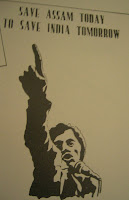
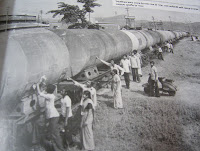
I had a sheltered childhood even though I was not remotely affected by the uprising. The only few memories I had was that when the lights went off while we were studying in the evenings, the black outs happened and in that silence one could hear gunshots in the nearby hills.... A man in the middle of the road in broad daylight, not far from my house had cut his chest and wrote from his blood- We Will Give Blood But Not Oil. (Tez Dim, Tel Nideu).. as if a warning to the Indian Government to stop exploiting Assam of its richness and to give back more. The road procession to Oil India campus during the Assam Agitation.. The endless trail of people walked passed our front door. I remember my parents getting buckets of water for the thirsty protesters. Today Assam has been liberally ploughed back with ample of money from the Central Government. The Assam Agitation followed by the new robin hoods that emerged and drifted away from the non violet agitators formed an armed group i.e. ULFA which had mass support and later the same ‘janta’ disowned them. What went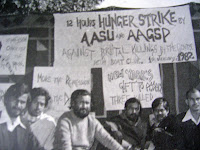
 wrong? What provoked or what motivated them to take up arms in the first place? What did they do to lose the trust from society later?
Friday December 23rd : Armed with just my driver in my dad’s old ambassador car, along with a trusted friend who could handle my camera, I was on my way to Upper Assam; to capture on film and to quench my thirst on a story what started as an uprising in the history of Assam: the formation of the most wanted separatist group in India- United Liberation Front of Assam (ULFA).
My documentary revolves around the families of the banned outfit. For me, they are the real heroes, who despite all the harassment & humiliation, continues to survive and live within the society. The courage and endeavour they must have been through- their only fault being that they belonged to families of the banned outfit. Being under scrutiny 24/7, their phone calls tapped, insulted at their own premises, getting threatening calls, mental harassments and sometimes even physical torture for something they have not done makes me wonder how they cope with it all and still continues to smile and live a normal life. I love my privacy and thinking of it makes me cringe.
My first destination was Arobindo Rajkhuwa’s place in Lakuwa, a remote corner in Assam’s Sibsagar district. One evening I contacted Rajkhuwa’s brother Ajoy in a very seedy hotel in Poltonbazar, Guwahati. I was apprehensive but he turned out to be a middle aged, decent and humble man. After a little chat with me, he invited me to his place the following week and that is where I was heading. I was lost in Sibsagar. My flashy cell phone lost its network too and I stopped to make a phone call only to find out that it was a police reserve. There I was in the beginning of my journey- lost network, no proper destination address and not a single known face around me. As we drove down the dark narrow bumpy road with little electricity, it made me wonder how a boy from this remote area had a vision for his land. It’s usually the have-nots that have it in them and AR was a true example.
I wanted to reach before dusk but failed to do so. The Rajkhuwa household had prepared a feast but my sole intention was to have a word with Aaita, Rajhkuwa’s ailing mother. I wanted to have a quiet moment with her but that was impossible as the entire dynasty gathered to be introduced and I was being my decent self exchanging pleasantries. By the time I got Aaita all for myself, my camera light was not working and I had to film in whatever light that was available there.
Aaita was a frail yet emotionally strong lady. She could barely see and felt my hands most of the time. She hoped that I would bring back her son which I rectified. I was there to talk to her about my documentary. Regardless, we talked. Her emotions were just unfolding and all I did was held her hand. She is in her nineties yet her strength made me feel weak. The more we talked; anger filled my mind for her son and a question inside- How could she still long for him after all the unpleasantness she endured from the army and society. He misled her from the very beginning. One morning as she was weaving in her front veranda, he clicked one last snap of his mother saying that he was off to the Namghar (shrine) for a few weeks. Months later she found out that he had joined the outfit.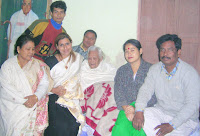
Aaita has lived many lives in one lifetime. She had the pride of being a freedom fighter’s wife. Years later, she was the Indian army’s target for being AR’s mother. If that was not enough she lost her first son to the secret killings that took place in the state. I have become almost blind crying all the time she said but I still hope to see xorupai (my youngest) one day. My last question to her: what will you say to him if you see him today? Without batting an eyelid she said- Ghoroloi gusi ah. Kheti kori kha- (Come home. Lead a simple farmer’s life here). I got very little sleep that night. Her words and her face were on my mind and added anger filled my mind for her son. My journey continued but her face stayed on my mind forever.
Back home in London I sat down to write to Arobindo Rajkhuwa- about my interaction with his mother and an email accusing him of what he had done to his mother and how could he hurt her deliberately. It was an email where I bombarded him with allegations and verbal brutality as I was certain, it would be a one way street. To my surprise an email arrived from the chairman himself, nothing aggressive compared to mine. Just saying -thank you for seeing my mother and for the photos. I miss her and have seen her after a very very long time. The last few last words saying - my motherland is greater than my mother.
Now this very man has been handed over by the Bangladesh government to the Indian intelligence. This all happened while he was just about to execute his exit from Bangladesh with his family and take a new secured shelter elsewhere. All we know is that no one has seen him since he joined the group. As I write this in Guwahati, he is just a few yards away from my home in Kahilipara where he is in safe housing. The media will flash his face over and over again from now onwards as the founder member and chairman of ULFA in custody. The Government might think that they just won a jackpot and that the key to their problem is under manacles.
The peace talks might be renewed but that to me is like boys with toys in a school playground- I shall bat, you ball and vice versa. You give me my boys back, we regroup, get stronger or is it just another senior level strategy that I have lost fate in?
These to me are very cosmetic. This will not get back our sheltered childhood, nor will it bring solace to the mothers who lost their loved ones in the decades of tragedy. Not even to the lady I met in Nowgaon during my filming, she had two sons- one joined ULFA, the other joined the police force- sadly both died- who is actually benefiting from this? Definitely not the people of Assam who are the real sufferers. Has anyone bothered to even ask their opinion?
Unless the government takes sovereignty in the agenda, no talks will happen with ULFA says their Commander in Chief Poresh Barua. Sovereignty is not in the constitution of the Indian Government. Now, the Indian constitution is a wonderful document and it can be amended as it has had 94 amendments in less than 60 years of its enactments. So what’s the harm in putting the word Sovereignty in the agenda? Amendments do not grant sovereignty, it will just open a dialogue and perhaps save millions of innocent lives and destructions in the coming years. What’s more important for the government? I feel everything in this world can be solved if people talk. The Government can decide if they want to amend the constitution again. Big Deal!
However, if we can address as to why it all started and if we can amicably solve that, I think we are laughing!
Bublee
India Trip 2005: There comes a time in your life where you finally want to walk the walk and talk the talk. This was such a trip. I just showcased my first short film and the success it had at Cannes International Film Festival, France; boosted my adrenalin to embark on my burning desire within- A documentary on the families of ULFA.
Now, I am far from being a journalist. The only experience I have, like many, is that I grew up in the dysfunctional state of Assam in the mid eighties. My questions were from my gut, from a housewife, from a daughter of the same soil. I wanted to capture the humane aspect of it from a common man/woman’s perspective. The only rule I had for myself -don’t have any judgements, don’t show any emotions. Let them talk- this story is about them- not YOU. You shall get your answers along the way. Have patience. Easier said than done! I wanted to react badly to most of their answers but somehow refrained myself from doing so.

I had a sheltered childhood even though I was not remotely affected by the uprising. The only few memories I had was that when the lights went off while we were studying in the evenings, the black outs happened and in that silence one could hear gunshots in the nearby hills.... A man in the middle of the road in broad daylight, not far from my house had cut his chest and wrote from his blood- We Will Give Blood But Not Oil. (Tez Dim, Tel Nideu).. as if a warning to the Indian Government to stop exploiting Assam of its richness and to give back more. The road procession to Oil India campus during the Assam Agitation.. The endless trail of people walked passed our front door. I remember my parents getting buckets of water for the thirsty protesters. Today Assam has been liberally ploughed back with ample of money from the Central Government. The Assam Agitation followed by the new robin hoods that emerged and drifted away from the non violet agitators formed an armed group i.e. ULFA which had mass support and later the same ‘janta’ disowned them. What went

 wrong? What provoked or what motivated them to take up arms in the first place? What did they do to lose the trust from society later?
Friday December 23rd : Armed with just my driver in my dad’s old ambassador car, along with a trusted friend who could handle my camera, I was on my way to Upper Assam; to capture on film and to quench my thirst on a story what started as an uprising in the history of Assam: the formation of the most wanted separatist group in India- United Liberation Front of Assam (ULFA).
My documentary revolves around the families of the banned outfit. For me, they are the real heroes, who despite all the harassment & humiliation, continues to survive and live within the society. The courage and endeavour they must have been through- their only fault being that they belonged to families of the banned outfit. Being under scrutiny 24/7, their phone calls tapped, insulted at their own premises, getting threatening calls, mental harassments and sometimes even physical torture for something they have not done makes me wonder how they cope with it all and still continues to smile and live a normal life. I love my privacy and thinking of it makes me cringe.
My first destination was Arobindo Rajkhuwa’s place in Lakuwa, a remote corner in Assam’s Sibsagar district. One evening I contacted Rajkhuwa’s brother Ajoy in a very seedy hotel in Poltonbazar, Guwahati. I was apprehensive but he turned out to be a middle aged, decent and humble man. After a little chat with me, he invited me to his place the following week and that is where I was heading. I was lost in Sibsagar. My flashy cell phone lost its network too and I stopped to make a phone call only to find out that it was a police reserve. There I was in the beginning of my journey- lost network, no proper destination address and not a single known face around me. As we drove down the dark narrow bumpy road with little electricity, it made me wonder how a boy from this remote area had a vision for his land. It’s usually the have-nots that have it in them and AR was a true example.
I wanted to reach before dusk but failed to do so. The Rajkhuwa household had prepared a feast but my sole intention was to have a word with Aaita, Rajhkuwa’s ailing mother. I wanted to have a quiet moment with her but that was impossible as the entire dynasty gathered to be introduced and I was being my decent self exchanging pleasantries. By the time I got Aaita all for myself, my camera light was not working and I had to film in whatever light that was available there.
Aaita was a frail yet emotionally strong lady. She could barely see and felt my hands most of the time. She hoped that I would bring back her son which I rectified.
 I was there to talk to her about my documentary. Regardless, we talked. Her emotions were just unfolding and all I did was held her hand. She is in her nineties yet her strength made me feel weak. The more we talked; anger filled my mind for her son and a question inside- How could she still long for him after all the unpleasantness she endured from the army and society. He misled her from the very beginning. One morning as she was weaving in her front veranda, he clicked one last snap of his mother saying that he was off to the Namghar (shrine) for a few weeks. Months later she found out that he had joined the outfit.
Aaita has lived many lives in one lifetime. She had the pride of being a freedom fighter’s wife. Years later, she was the Indian army’s target for being AR’s mother. If that was not enough she lost her first son to the secret killings that took place in the state. I have become almost blind crying all the time she said but I still hope to see xorupai (my youngest) one day. My last question to her: what will you say to him if you see him today? Without batting an eyelid she said- Ghoroloi gusi ah. Kheti kori kha- (Come home. Lead a simple farmer’s life here). I got very little sleep that night. Her words and her face were on my mind and added anger filled my mind for her son. My journey continued but her face stayed on my mind forever.
Back home in London I sat down to write to Arobindo Rajkhuwa- about my interaction with his mother and an email accusing him of what he had done to his mother and how could he hurt her deliberately. It was an email where I bombarded him with allegations and verbal brutality as I was certain, it would be a one way street. To my surprise an email arrived from the chairman himself, nothing aggressive compared to mine. Just saying -thank you for seeing my mother and for the photos. I miss her and have seen her after a very very long time. The last few last words saying - my motherland is greater than my mother.
Now this very man has been handed over by the Bangladesh government to the Indian intelligence. This all happened while he was just about to execute his exit from Bangladesh with his family and take a new secured shelter elsewhere. All we know is that no one has seen him since he joined the group. As I write this in Guwahati, he is just a few yards away from my home in Kahilipara where he is in safe housing. The media will flash his face over and over again from now onwards as the founder member and chairman of ULFA in custody. The Government might think that they just won a jackpot and that the key to their problem is under manacles.
The peace talks might be renewed but that to me is like boys with toys in a school playground- I shall bat, you ball and vice versa. You give me my boys back, we regroup, get stronger or is it just another senior level strategy that I have lost fate in?
These to me are very cosmetic. This will not get back our sheltered childhood, nor will it bring solace to the mothers who lost their loved ones in the decades of tragedy. Not even to the lady I met in Nowgaon during my filming, she had two sons- one joined ULFA, the other joined the police force- sadly both died- who is actually benefiting from this? Definitely not the people of Assam who are the real sufferers. Has anyone bothered to even ask their opinion?
Unless the government takes sovereignty in the agenda, no talks will happen with ULFA says their Commander in Chief Poresh Barua. Sovereignty is not in the constitution of the Indian Government. Now, the Indian constitution is a wonderful document and it can be amended as it has had 94 amendments in less than 60 years of its enactments. So what’s the harm in putting the word Sovereignty in the agenda? Amendments do not grant sovereignty, it will just open a dialogue and perhaps save millions of innocent lives and destructions in the coming years. What’s more important for the government? I feel everything in this world can be solved if people talk. The Government can decide if they want to amend the constitution again. Big Deal!
However, if we can address as to why it all started and if we can amicably solve that, I think we are laughing!
Bublee


